Chicken Coop Lighting Egg Production
Chicken Coop Lighting Egg Production
Of all the management levers a backyard flock owner can pull, light is the one with the most direct and predictable effect on the nest box. Understanding how much light do chickens need to lay explains why a healthy, well-fed hen can go quiet in November and start up again in February without any change in feed, housing, or care. This page expands on the lighting section of our main guide to chickens not laying eggs and walks through the biology, the numbers, and a practical procedure for adding light without harming the flock.
Why Light — Not Temperature — Drives the Laying Cycle
Chickens are long-day breeders. In the wild ancestors of the modern hen, raising chicks was only worth the energy investment when days were lengthening and food was abundant, so reproduction became tied to photoperiod rather than to warmth. Cold weather alone does not shut down the ovary; shortening days do. This is why flocks in heated garages still slow down in December and why hens in unheated coops in northern states often resume laying in late winter while snow is still on the ground.
The mechanism is hormonal. Poultry researchers describe light being detected not only by the eyes but also by photoreceptive cells deep in the brain, near the hypothalamus, with light energy passing through the skull and thin tissue. When the perceived day length crosses a threshold, the hypothalamus releases gonadotropin-releasing hormone, which signals the pituitary gland to secrete follicle-stimulating hormone and luteinizing hormone. Those hormones drive the maturation of yolks in the ovary and trigger ovulation. Reduce the stimulating light, and the cascade slows or stops, the ovary regresses, and the hen redirects nutrients toward maintenance and feather regrowth instead of eggs.
Two details matter for anyone reading this chicken coop lighting egg production guide for layers for the first time. First, birds respond mainly to the direction of change in day length, not simply to the absolute number of hours — increasing photoperiods stimulate, and decreasing photoperiods suppress. Second, ovulation runs on a cycle slightly longer than 24 hours, roughly 24 to 26 hours in most hens, and a hen will not usually ovulate in the dark. Because of that internal clock, each egg is laid a little later in the day than the last until the hen reaches the end of her sequence, skips a day, and resets. That is why an otherwise productive hen naturally has an occasional off day.
Daylight Hours and Laying: The Numbers Backyard Keepers Should Know
Light Threshold Requirements for Egg Production
Extension poultry specialists generally cite a working threshold of about 12 hours of light per day to maintain any meaningful production, with 14 to 16 hours considered the range where most laying strains perform at their peak. Below roughly 12 hours, production tapers; below 10, many hens stop entirely. The relationship between daylight hours and laying is not a light switch but a slope, and individual hens differ — a first-year hybrid layer may keep going on 11 hours while a heritage-breed third-year hen quits at 13.
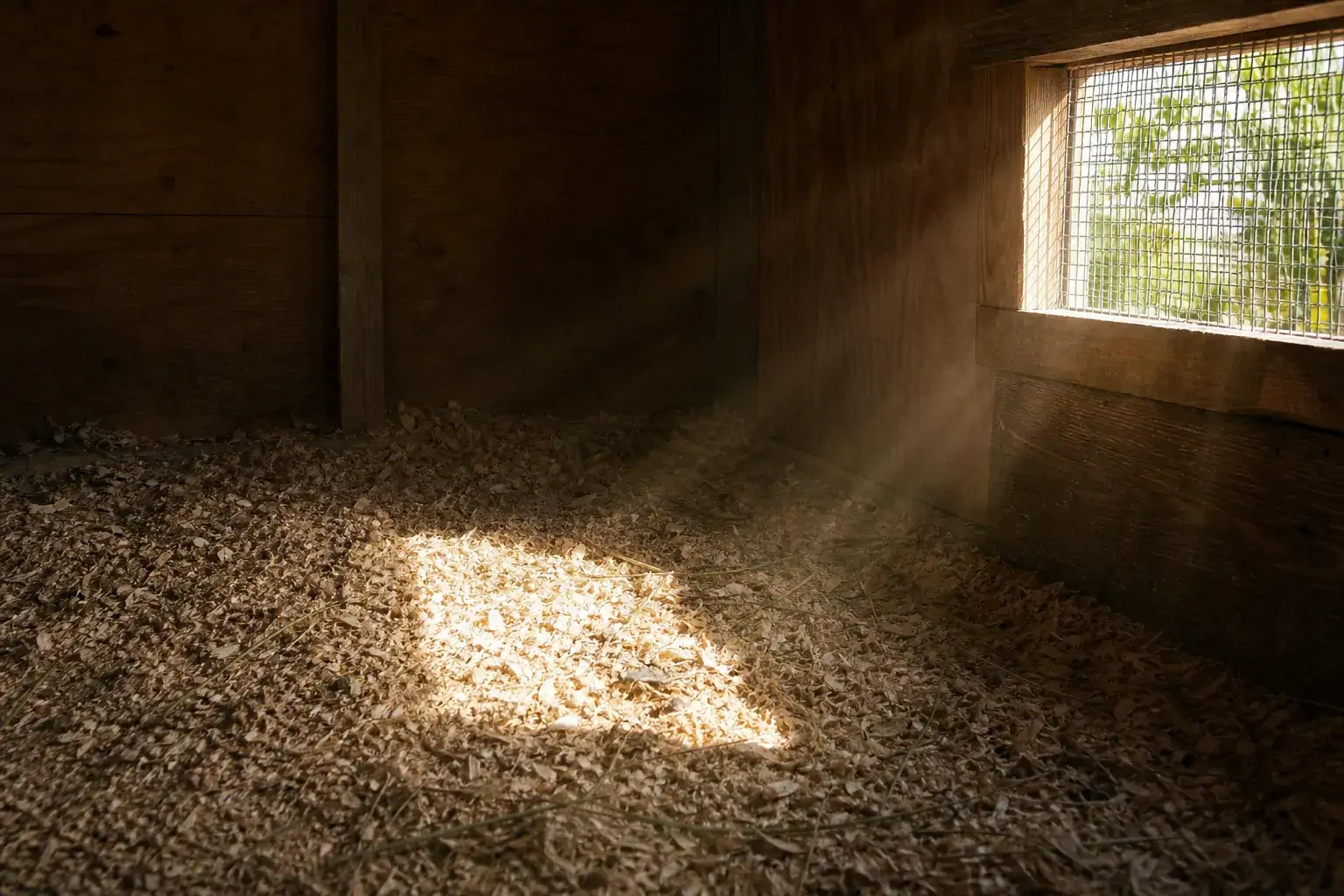
Natural day length depends on latitude. The table below gives approximate midwinter and midsummer daylight for a range of US locations to show how dramatic the swing is in northern states.
| Approximate Latitude (example area) | Daylight near Dec 21 | Daylight near Jun 21 | Winter lighting usually needed? |
|---|---|---|---|
| ~26°N (south Texas, south Florida) | ~10.5 hours | ~13.8 hours | Often optional; mild slowdown |
| ~35°N (Tennessee, Oklahoma, Arizona) | ~9.8 hours | ~14.3 hours | Helpful for steady output |
| ~42°N (Iowa, Massachusetts, Oregon) | ~9.0 hours | ~15.3 hours | Commonly used |
| ~47°N (Montana, Minnesota, Washington) | ~8.3 hours | ~16.0 hours | Most often used |
Reading down that table clarifies the seasonal pattern most keepers observe. A flock in Minnesota loses nearly eight hours of daylight between the solstices, which is more than enough to shut down the ovary completely, while a flock in south Florida may only dip in output. Anyone weighing whether to use artificial light for winter eggs should start by looking up local sunrise and sunset times for late December, then compare that figure to the 12-hour threshold to see how large the gap actually is.
Latitude and Your Lighting Needs
The dramatic variations in daylight hours across different US regions mean that does lighting affect egg production differently depending on where you live. Northern keepers face steeper winter drops in natural daylight and typically benefit most from supplemental lighting strategies.
Deciding Whether to Add Light at All
Evaluating Your Flock for Supplemental Lighting
Supplemental lighting is a management choice, not a requirement, and it is worth thinking through before running an extension cord. Several factors influence the decision:
- Flock age. Pullets that are not yet at point of lay should generally not be pushed with long photoperiods, since premature stimulation can be associated with small eggs and prolapse risk in immature birds. Commercial programs delay stimulatory lighting until pullets reach target body weight and maturity.
- Molt status. A hen in heavy molt is diverting protein into feathers, and light will not override that. Adding light during molt tends to accomplish little; more detail on that pause appears in the molt discussion below.
- Breed and strain. Production hybrids such as Leghorn-type and sex-link birds are far more light-responsive and persistent than many heritage or ornamental breeds. Cold hardy chicken breeds tend to handle the natural drop in winter daylight better overall, though they still respond to the same lighting principles as other layers.
- Longevity concerns. A hen is born with a finite number of ova, and some keepers prefer to let the natural winter rest lengthen the productive years. Published research on whether supplemental winter light meaningfully shortens a backyard hen's total lifetime output is mixed, and genetics and nutrition appear to play larger roles. Both approaches are defensible.
- Bird welfare and rest. Hens need a continuous dark period — typically at least six to eight uninterrupted hours — for rest, and 24-hour lighting is never appropriate.
Keepers who decide against lights can still improve winter numbers with good nutrition, draft-free ventilation, clean water that never freezes, and young replacement pullets added in late summer. Those who decide in favor should follow a deliberate plan rather than simply leaving a shop light on overnight.
Alternatives to Artificial Lighting
Beyond supplemental lighting, improved nutrition, fresh water access, and young replacement hens can help maintain supplemental lighting chickens 14 hours equivalent production through natural means without additional infrastructure.
Setting Up Supplemental Lighting: A Step-by-Step Procedure
The following sequence reflects the general approach recommended in university extension publications and poultry husbandry references. Working through it in order prevents the two most common problems with setting up supplemental lighting: fire risk and abrupt hormonal swings.
Confirm light is really the limiting factor. Before adding bulbs, rule out the other common causes of a production drop — active molt, hidden nests, egg eating, predator pressure, parasites, sudden feed changes, or a flock that has simply aged out of peak lay. Lighting corrects a photoperiod deficit and nothing else, so a hen that stopped because of mites or a diet dilution problem will not respond. Recording daily egg counts for two weeks gives a baseline for judging whether the change worked.
Choose a target photoperiod and hold it steady. Most backyard programs settle on supplemental lighting chickens 14 hours of total light, counting natural daylight. Fourteen hours is enough to keep the reproductive axis active in most laying strains without pushing the birds hard. Once chosen, the target should not be reduced mid-winter, because a drop in day length is itself a suppressive signal.
Add the extra hours in the morning, not the evening. Morning lighting is the standard recommendation for a simple welfare reason: when a timer clicks off at night, the coop goes instantly dark and birds can be caught off the roost, disoriented on the floor. With morning lighting, the artificial period ends as natural daylight takes over, so birds always settle to roost in fading natural light. If evening light must be used, a dimming fixture or a small night-light that fades gradually helps birds find perches.
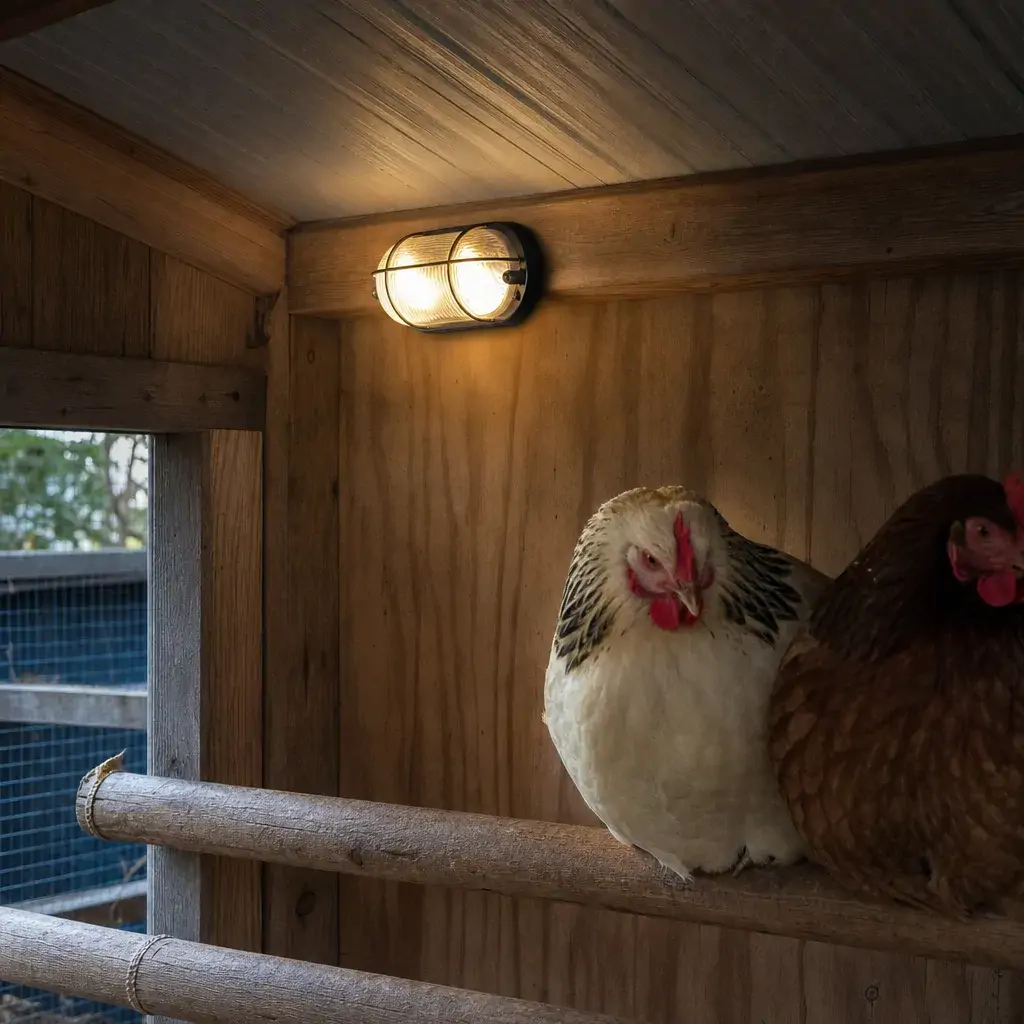
Select the bulb type and color temperature. Warm-white bulbs in the 2,700K to 3,000K range, or bulbs with strong output in the red and orange wavelengths, are generally favored for stimulating lay, since research on poultry vision indicates longer wavelengths are effective at reaching the hypothalamic photoreceptors. Cool blue-white light is less stimulatory for reproduction. Whatever the source, it must be an enclosed or shatter-resistant fixture rated for damp, dusty locations.
Get the intensity right — bright enough, not blinding. Poultry references commonly cite roughly 5 to 10 lux at bird level as sufficient for layers, which is dimmer than most people expect: it is about the level at which a newspaper headline is readable but small print is not. A practical field rule used in extension bulletins is roughly one incandescent watt per four square feet of floor space, meaning a 40- to 60-watt incandescent equivalent covers a typical 10-by-10-foot coop. For LEDs, that translates to something in the 6- to 9-watt range. Excessive brightness wastes electricity and has been associated with increased pecking and aggression.
Position the fixture for even coverage. Mount the light high enough to be out of reach of the birds and away from bedding, roosts, and nest boxes so hens are not lit while trying to lay in a dark, private space. Aim for reasonably uniform illumination rather than one hot spot; two low-wattage bulbs in a long coop beat a single bright one. Reflective interior surfaces such as light-colored plywood improve distribution.
Wire it safely. Coops are dusty, humid, feather-filled environments — an ideal setting for an electrical fire. Use outdoor-rated cable, a GFCI-protected circuit, secure permanent mounting rather than dangling cords, and keep all wiring where birds cannot peck it or roost above it. Avoid heat lamps as a light source; they are a leading cause of coop fires and are not needed for photoperiod. Low-voltage or solar-plus-battery systems are popular for coops without wired power, and their small draw suits the low intensity layers require.
Install a reliable chicken coop light timer. A programmable digital timer with battery backup for its memory is more precise than a mechanical dial and will not drift or reset after a power blip. Some keepers use astronomical timers that adjust automatically to local sunrise. Whichever is used, the on-time is set early in the morning and the off-time is set for shortly after natural sunrise, and both are adjusted every few weeks as sunrise shifts through the season.
Increase day length gradually. Rather than jumping from nine hours to fifteen overnight, most guidance suggests adding roughly 30 to 60 minutes of light per week until the target is reached. A gradual ramp mimics the natural spring lengthening the hen's physiology evolved to read, and it reduces the risk of stress-related problems. Starting the ramp in early fall, before natural day length falls below the threshold, is more effective than trying to restart a flock that has already gone fully out of production.
Match nutrition to the increased workload. A hen laying through winter needs a complete layer ration of about 16 to 18 percent protein with adequate calcium, plus free-choice oyster shell offered separately so individual birds can self-regulate. Cold weather raises maintenance energy needs, so heavy scratch-grain treats that dilute the balanced ration are counterproductive. Unfrozen water is non-negotiable, since even brief water restriction depresses lay quickly. Any coop lighting guide for layers that ignores feed and water misses half the equation, because light only sets the schedule — nutrients build the egg.
Taper off in spring, not abruptly. Once natural daylight exceeds the artificial target, the supplement becomes unnecessary. Reducing artificial light by 15 to 30 minutes per week as natural days lengthen avoids a sudden perceived decrease. Many keepers simply let natural daylight overtake the timer setting and then switch the system off.
Keep records and reassess each season. Logging daily egg counts, the current timer settings, feed type, and any health observations turns guesswork into a repeatable program. Comparing two winters of records shows whether the lighting plan is earning its keep for a particular flock and climate.
Bulb Options Compared
Choosing the Right Light Bulb for Your Coop
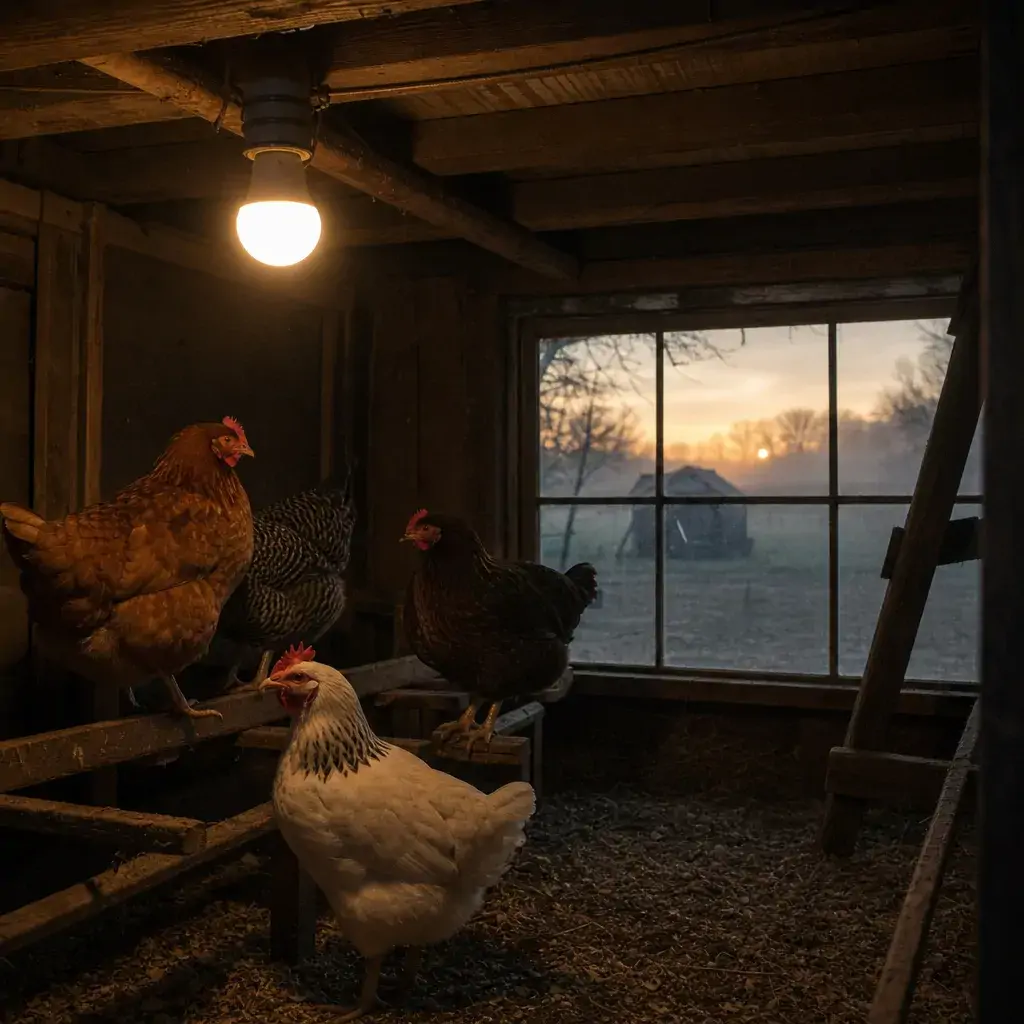
Bulb choice affects cost, safety, and how well the light stimulates the birds. The comparison below summarizes the general characteristics of the options commonly used when setting up chicken coop lighting egg production systems in a small coop.
| Feature | Incandescent | LED (warm white) | Compact fluorescent |
|---|---|---|---|
| Spectrum for layers | Rich in red/orange wavelengths; historically the reference standard | Good if 2,700K–3,000K warm white is chosen; poultry-specific models exist | Often cooler and spikier in output; less consistently favorable |
| Energy use | Highest | Lowest, roughly 80–85% less than incandescent for equal brightness | Moderate |
| Cold-weather behavior | Works well; produces waste heat | Works well; check that the model is rated for low temperatures | Can be slow to reach full brightness in cold coops |
| Dimming compatibility | Generally simple | Only with dimmable models and matched dimmers | Frequently poor |
| Durability in dust and vibration | Fragile filament; glass breakage risk | Robust; shatter-resistant versions widely available | Glass tube plus mercury content complicates breakage cleanup |
| Best suited to | Keepers who want the traditional spectrum and can accept higher power draw | Most backyard setups, and any solar or battery-powered system | Generally the least attractive of the three for coop use |
LED vs. Incandescent Lighting Systems
For most backyard operations, LED bulbs represent the modern choice due to efficiency and durability, though traditional incandescent remains popular among keepers who prioritize spectrum and warmth output for their flocks.
Completion Checklist
A lighting program is set up correctly when all of the following are true:
- Total light per day, natural plus artificial, is steady at the chosen 14- to 15-hour target.
- The supplement runs in the pre-dawn hours and switches off after natural sunrise.
- Birds have a single uninterrupted dark period of at least six to eight hours every night.
- Light at bird level is dim but adequate — readable headline level, not floodlight bright — and reasonably even across the floor.
- The fixture is enclosed, dust- and moisture-rated, mounted out of reach, and on a GFCI-protected circuit with no dangling cords.
- No heat lamp is being used as the light source.
- A timer with memory backup controls the schedule, and its settings are reviewed every two to three weeks.
- Day length was increased in weekly increments of about half an hour rather than all at once.
- A complete layer ration, free-choice calcium, and unfrozen water are available at all times.
- Egg counts and settings are being recorded so results can be evaluated.
Common Mistakes That Undermine Results
Several recurring errors explain why some flocks fail to respond to artificial light for winter eggs. Leaving lights on 24 hours a day denies birds rest and does not increase output beyond the 16- to 17-hour ceiling. Using a very bright bulb invites feather pecking and higher power bills without additional stimulation. Shortening the photoperiod mid-season — for instance, switching lights off during a warm spell — sends a suppressive signal that can take weeks to reverse. Lighting a flock that is in full molt or is composed largely of hens past their third or fourth year produces disappointing returns regardless of how carefully the timer is programmed. Finally, expecting lighting to correct a nutritional or parasite problem confuses the schedule with the raw materials; the relationship between daylight hours and laying only functions when the hen is otherwise healthy and properly fed.
When to Consult a Veterinarian or Poultry Expert
Lighting is a management tool, not a treatment, and certain observations warrant professional input rather than another adjustment to the timer. A hen that strains, stands penguin-upright, or repeatedly visits the nest without producing an egg is showing signs that should prompt a call to a veterinarian experienced with poultry. Persistently misshapen, thin, or shell-less eggs after weeks of adequate calcium is a sign an expert evaluation is appropriate, since several nutritional and infectious causes can look similar. Occasionally noticing blood in chicken egg is usually harmless, but if it happens repeatedly it is worth mentioning to your vet. Lethargy, a pale or shrunken comb, labored breathing, sudden weight loss, watery or discolored droppings, or a swollen abdomen are all indications that a qualified veterinarian or a state extension poultry specialist should assess the bird. A flock-wide collapse in production accompanied by respiratory noise or unusual mortality is likewise a situation for professional diagnosis, not home management. Backyard keepers can also contact their state agricultural extension office or state veterinarian's office, both of which commonly provide poultry health guidance to small flock owners.
Related Reading
Because lighting overlaps with several other production questions, it helps to read alongside the seasonal and physiological topics. The broader seasonal picture, including cold-weather nutrition and shelter, is covered in the discussion of chickens laying eggs in winter. Because supplemental light cannot override feather regrowth, the timing details in molting and egg production explain why autumn additions sometimes appear to do nothing. And when a flock is several years old, the expectations laid out in laying decline by age often matter more than photoperiod.
Bottom Line
A properly designed lighting program — gradual, morning-based, dim, safely wired, and paired with sound nutrition — is the most reliable way to hold winter production steady, and knowing exactly how much light do chickens need to lay is what separates a helpful supplement from an unnecessary one.